

Mindscape Health is now available on Windows, Mac & Android

WELLNESS & SELF-CARE

How Journaling Improves Mental Health

The simple act of putting pen to paper can reduce anxiety, clarify your thoughts, and build emotional resilience — here is the science behind why it works and how to start.

There is a reason therapists across every discipline recommend journaling. It is one of the simplest, most accessible mental health tools available — requiring nothing more than a few minutes and a willingness to be honest with yourself. Whether you are navigating anxiety, processing grief, or simply trying to understand your own patterns, writing creates a bridge between your inner world and clarity.

Journaling is not about producing beautiful prose or filling pages. It is about creating a private space where your thoughts can exist outside your head — where they become something you can observe, question, and ultimately understand. This guide explores the research behind journaling, practical techniques you can use today, and how to build a habit that lasts.

The Science of Writing It Down

The therapeutic power of journaling is not folk wisdom — it is backed by decades of rigorous research. Dr. James Pennebaker, a psychologist at the University of Texas at Austin, pioneered the study of expressive writing in the 1980s. His landmark experiments showed that people who wrote about their deepest thoughts and feelings for just 15-20 minutes a day over four consecutive days experienced measurable improvements in both mental and physical health.

Reduced amygdala activity

Neuroimaging studies show that labeling emotions through writing reduces activity in the amygdala — your brain's threat detection center. When you name what you feel, the emotional intensity decreases. Researchers call this "affect labeling," and it works whether you speak the words or write them down.

Narrative processing

Writing forces your brain to organize chaotic thoughts into a coherent narrative. This engages the prefrontal cortex — responsible for reasoning and perspective — and helps you move from emotional overwhelm to structured understanding. Pennebaker found that participants who developed a clear narrative over their writing sessions showed the greatest health improvements.

Stress hormone reduction

Regular expressive writing has been shown to lower cortisol levels over time. Pennebaker's participants reported fewer visits to the doctor, improved immune function, and lower blood pressure — all markers of reduced chronic stress.

The key insight from the research is that journaling works not because it helps you vent, but because it helps you make sense of your experiences. The act of translating emotions into language creates cognitive structure where there was none.

Gratitude Journaling

If expressive writing helps you process what is difficult, gratitude journaling helps you notice what is good. The "Three Good Things" practice — writing down three things you are grateful for each day — is one of the most well-studied positive psychology interventions in existence.
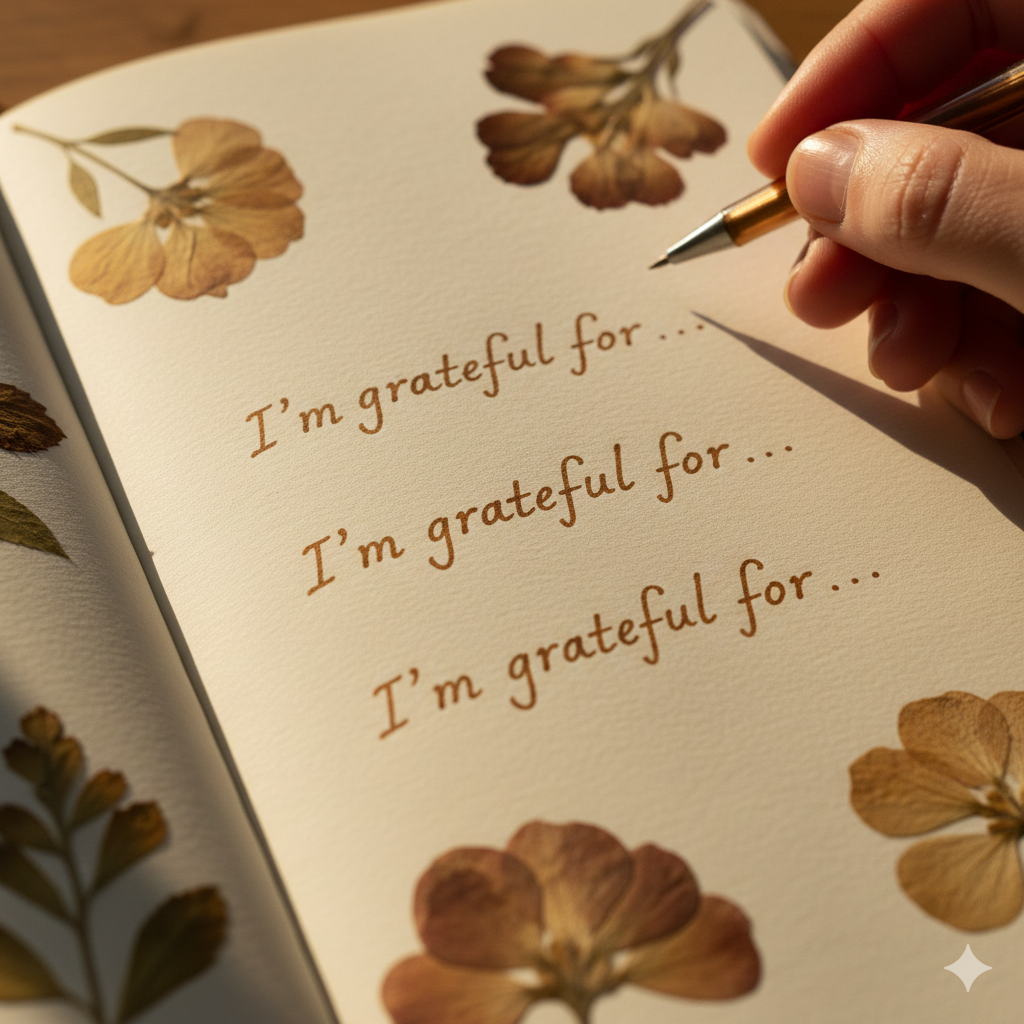
A person writing in a gratitude journal with warm lighting
Writing down three things you're grateful for each day rewires your brain to notice the good — even on difficult days.

The practice works by shifting your attention bias. Your brain naturally prioritizes threats and problems — a survival mechanism that served our ancestors well but leaves modern humans fixated on what is wrong. Gratitude journaling trains your brain to also scan for positive experiences, creating a more balanced perception of your daily life.

Research published in the Journal of Personality and Social Psychology found that participants who kept a gratitude journal for just two weeks reported significantly higher levels of well-being, optimism, and life satisfaction compared to control groups. They also exercised more and had fewer physical complaints. The improvements were not because their lives changed — it was because their attention changed.

How to Practice Three Good Things

Step 1: Each evening, write down three things that went well during the day. They do not need to be extraordinary — "I had a good conversation with a friend" or "The weather was beautiful this morning" count.

Step 2: Next to each item, write a brief note about why it happened. This encourages you to reflect on causes rather than just outcomes — "because I made the effort to call her" or "because I chose to walk instead of driving."

Step 3: Commit to this practice for at least 14 consecutive days. Research suggests this is the minimum duration needed to begin shifting your default attention patterns.

Processing Difficult Emotions

When you are anxious, angry, or sad, your thoughts can feel like a storm inside your head — fast, tangled, and impossible to sort through. Journaling gives those thoughts somewhere to go. The technique is simple: write without stopping, without editing, and without judgment.

An open journal with handwritten entries expressing thoughts and emotions
Journaling gives your thoughts a place to land — moving them from the chaos of your mind onto a page where you can examine them clearly.

This approach is often called stream-of-consciousness writing or a brain dump. The rules are deliberately minimal: set a timer for 10-15 minutes and write whatever comes to mind. Do not worry about grammar, spelling, or whether it makes sense. The goal is to externalize what is inside — to move the weight from your mind onto the page.

When you are anxious: Write down every worry, no matter how irrational it seems. Once your fears are on paper, they often appear smaller and more manageable. You can then ask yourself: "Which of these can I actually control?" and "What is the most likely outcome?"

When you are angry: Let the words be raw. A journal is a private space — you do not need to be fair, balanced, or polite. Getting the anger out of your body and onto paper prevents it from being directed at people you care about or turned inward against yourself.

When you are sad: Describe the sadness without trying to fix it. Write about what triggered it, how it feels in your body, and what you wish someone understood. Sometimes grief and sadness need to be witnessed — even if the only witness is your own written words.

Journaling Prompts to Get Started

Staring at a blank page can feel intimidating. These prompts are designed to bypass the inner critic and get your pen moving. Choose one that resonates — there is no wrong answer.

What am I feeling right now, and where do I feel it in my body?

What would I tell a friend who was going through what I am going through?

What is one thing I am avoiding, and why?

What am I most grateful for today, and what made it meaningful?

If I could let go of one worry right now, what would it be?

What does my ideal tomorrow look like?

What is something I did well this week that I have not acknowledged?

What would I do differently if I were not afraid?

Who made me feel seen or supported recently, and how?

What is weighing on me that I have not said out loud yet?

Making It a Habit

Knowing the benefits of journaling is one thing — actually doing it consistently is another. The biggest mistake people make is setting expectations too high: they imagine filling entire pages with eloquent reflections every day, and when reality falls short, they quit. The goal is not perfect entries — it is consistent practice.

A simple journaling setup with a notebook and coffee, suggesting an easy daily routine
The goal isn't perfect entries — it's consistent practice. Even two minutes of writing each day builds the mental health benefits over time.
  • Same time daily: Anchor your journaling to a specific time. Morning pages help you set intentions for the day; evening writing helps you process and decompress. Pick whichever fits your natural rhythm and protect that time.
  • Start with two minutes: The barrier to entry should be almost nonexistent. Two minutes of writing is better than zero minutes of perfection. Once you sit down and start, you will often write longer — but the commitment is only two minutes.
  • Pair it with an existing habit: Attach journaling to something you already do. Write with your morning coffee, during your lunch break, or as part of your bedtime routine. Habit stacking makes new behaviors stick.
  • Do not judge your writing: Your journal is not a performance. It is a tool. Messy handwriting, incomplete sentences, and contradictory thoughts are all fine. The moment you start evaluating quality, you create resistance.
  • Digital vs. paper — both work: Research shows benefits from both handwriting and typing. Handwriting activates more motor areas of the brain and can feel more personal. Digital journaling is searchable, always available on your phone, and easier to maintain. Choose whichever removes friction for you.

Digital Journaling with MindScape

MindScape's built-in journal feature was designed to make consistent journaling effortless. Your entries are completely private — only you can see what you write. The interface is clean and distraction-free, so you can focus on your thoughts rather than navigating complicated software.

Private and secure

Your journal entries are yours alone. MindScape keeps your writing private so you can be completely honest without worrying about who might read it.

Searchable entries

Unlike paper journals, your digital entries are fully searchable. Want to revisit what you wrote during a difficult period or find a specific insight? A quick search brings it up instantly.

Pairs with mood tracking

When you journal alongside your daily mood check-ins, patterns emerge. You can see which thoughts and situations correspond to mood shifts — giving you concrete insights into your emotional life rather than vague impressions.

Whether you use MindScape's journal as your primary tool or as a supplement to a paper notebook, the important thing is that you have a dedicated space for self-reflection that is always with you.

Start Journaling Now

You do not need the perfect notebook, the perfect prompt, or the perfect time. You just need to begin. Open your MindScape journal and write your first entry today — even if it is only two sentences.